
Budo Scholar
How to find a martial arts school
The right martial arts school gives you a qualified instructor and a safe, supportive community to train with. The choice of art and school is yours. Budo Scholar is a leadership program, and part of leadership is making good choices and taking responsibility for getting the information you need to make them. This guide walks you through it, one step at a time.
Step 1 of 4
How do you know which martial art is right for you?
Start with what you want out of training. Maybe you're looking for self-defense, confidence, fitness, community, cultural enrichment or competition. Or maybe you want to learn how to get good at something hard.
Then watch martial arts videos and see what you like. Maybe you get pulled into grappling matches, or you're drawn to Japanese sword kata.
The art matters less than most beginners expect. The instructor and the people you train with matter more, and most people grow into whichever art they started with.
Don’t get lost in online arguments. The internet is full of people saying one art is useless and another is the only one that works. But even “what works” depends on the situation: on the ground or on your feet, one attacker or several, empty hands or a weapon. And for many people, fighting effectiveness isn’t the main reason to train at all. Few would call Kendo a practical self-defense art, yet it’s loved and practiced by people around the world. Most people who train for years stay for other reasons: the art itself, the people, the challenge, who they become. The right art is the one that inspires you, taught well, at a school you’ll keep showing up to.
Questions to ask yourself
- What do you want to be able to do a year from now that you can't do today?
- How do you want to feel walking out of a class?
- Do you want to compete, or would you rather never compete?
- Are you drawn to grappling, striking, throwing, or working with weapons?
- How many days a week can you get there?
The arts in a few sentences
Brazilian Jiu-Jitsu
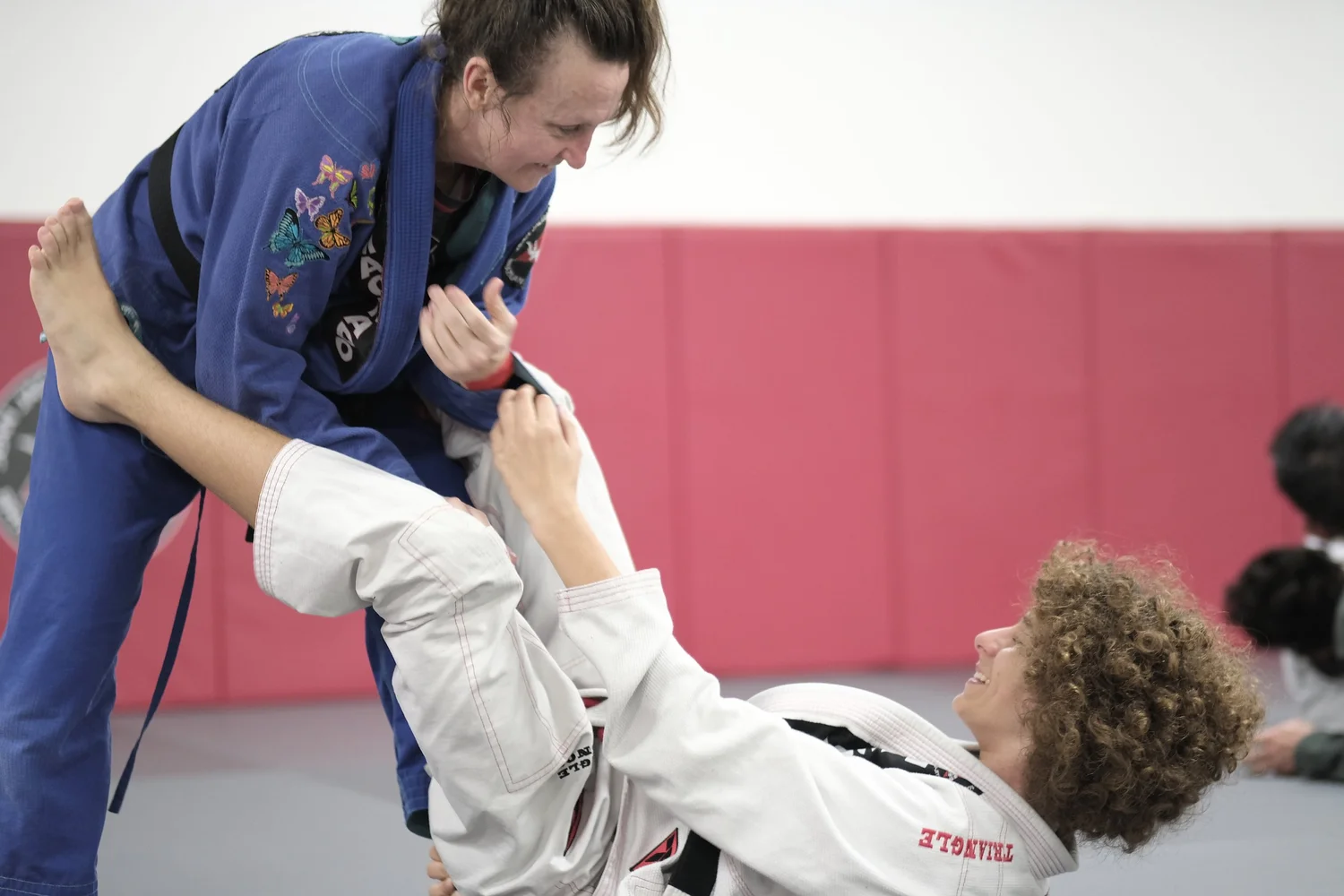
Grappling, mostly on the ground. The goal is to reach a dominant position, hold it, and finish with a choke or joint lock. Training includes live rounds against resisting partners from early on. Practiced with and without the gi.
Aikido
A Japanese art that redirects an attacker's momentum into throws and joint locks. Training is cooperative, so classes are technique and falling practice, with little or no sparring. The focus varies by school, from practical self-defense to classical forms and philosophy.
Filipino martial arts
Also called kali, escrima, or arnis. Training begins with sticks and blades and adds empty-hand techniques later, since the movements are the same. Classes are built around partner drills that develop coordination and hand speed.
Judo
Throwing an opponent to the ground, then pinning or submitting them. Falling safely is taught first. Judo is an Olympic sport, so most schools include live practice against resisting partners.
Karate
Striking with punches, kicks, and blocks, taught through stances, set forms (kata), and partner work. Styles vary widely in contact level, from light-touch traditional schools to full-contact sparring, so ask which a school practices.
Kendo
Japanese fencing with bamboo swords and protective armor. Points are scored on clean strikes to the head, wrist, body, or throat. Practice emphasizes footwork, timing, and committed attacks.
Boxing
Punches only, along with footwork, head movement, and defense. Classes are built on bag work, pad work, and conditioning. Most gyms include sparring once fundamentals are in place.
Wrestling
Takedowns, control, and pins, with no strikes or submissions. It is a scholastic and Olympic sport and one of the most physically demanding to train. Common styles are folkstyle, freestyle, and Greco-Roman.
Muay Thai
Thailand's national striking art, using punches, kicks, knees, and elbows, plus clinch work at close range. Classes are built on pad rounds, bag work, and repetition. Most gyms include sparring.
Kickboxing
Punches and kicks, trained on pads and bags before partner work. The term covers everything from fitness classes to full-contact competition, so check whether a school spars and under what rules.
Taekwondo
A Korean art centered on kicking at every height and angle, plus set forms (poomsae) and flexibility work. It is an Olympic sport with a structured belt system and is widely taught to beginners of all ages. Sparring is usually Olympic style, with protective gear and points scored for kicks to the body and head, though contact level varies by school.
Kung Fu
An umbrella term for hundreds of Chinese styles, including Wing Chun, Hung Gar, and Shaolin. Most schools teach stances, forms, and striking, with traditional weapons at advanced levels. The amount of live sparring varies by school.
Wushu
The modern sport form of Chinese martial arts. It has two branches: taolu, the acrobatic forms and weapons routines seen in competition, and sanda, a full-contact fighting event with punches, kicks, and throws. Most schools focus on taolu.
Krav Maga
A self-defense system rather than a sport, originally developed for the Israeli military. Training covers simple strikes, escapes, and awareness under stress. Instruction quality varies more than in most arts, so check the instructor's certification and lineage.
MMA
Striking and grappling combined under a single rule set, along with the transitions between them. Most gyms teach the components in separate classes (boxing, Muay Thai, wrestling, jiu-jitsu) and add MMA-specific sessions for putting them together.
And many more
There are far more arts than we can list, from capoeira to sambo to hapkido. Use this as a starting point, and ask any school what its art is like to train.
Step 2 of 4
Find a few schools you can get to reliably
Distance is the most common reason people stop training. Look for somewhere you can get to on a normal week, at class times you can actually make: near home, near school, or along a route you already travel.
Two or three names is enough to start.
How to find them
- Search for the specific art near you, not just “martial arts”.
- Read the recent reviews rather than the overall rating, and look for what people say about the instructors.
- If you know anyone who trains, ask them where they would send a friend.
- Check the class schedule for beginner classes at times that work for you.
Step 3 of 4
Visit, watch a class, and ask questions
- Send a short message first. Say your age, say you're new, and ask when a beginner could come and watch or try a class. How a school answers, and how quickly, tells you something already.
- Watch a full class before you take one. Any school worth joining will say yes.
- Bring a parent or a friend if you're under eighteen. A second set of eyes will catch things you miss.
- Visit on a normal week, at the time you would actually train, not at a demo or an open house.
- Visit more than one school if you can. It's easier to judge a place when you have something to compare it to.
Ask these when you visit the school
- Who teaches the classes I would be in?
- What does a beginner's first month look like?
- What is the full monthly cost, and what else do I have to buy on top of it?
- Is there a contract, how long is it, and how do I cancel?
- Are the instructors background checked, and what is the policy for adults training with students under eighteen?
- How many other students my age train here, and in which classes?
Get the answers about cost and contracts in writing before you sign anything.
Step 4 of 4
Watch for these signs
While you watch or try a class, notice how the school and its students treat people. One red flag on its own may not mean much. Several together usually do. Trust your instincts. If a place feels wrong and the feeling doesn't fade by the end of your visit, look for another school.
Green flags
- Beginners are looked after, and learn and drill before they're put into hard sparring.
- The senior students help the newer ones.
- People seem glad to be there.
- The place is clean.
- You can ask questions without it being awkward.
- Nobody pressures you on your first visit.
- There are classes at times you can actually make.
- Classes are co-ed, and any women's only class is taught and run by women.
- Parents are welcome to watch any class, any day, without arranging it first.
Red flags
- You're pushed to sign something before you've trained.
- The cost isn't clear, or there are fees nobody mentioned up front.
- Injuries get brushed off.
- The instructor can't be questioned or corrected.
- You're discouraged from training anywhere else, or visitors aren't welcome.
- Someone is singled out or humiliated in front of the class.
- Parents are kept out of the training area.
- The place is dirty.
- You leave feeling worse about yourself than when you arrived.
Watch
Videos worth watching
Teachers and athletes on how to choose a school, and what to watch out for.
For students under 18
Lines a school should never cross
If you're under eighteen, these are signs to find another martial arts school. If any of them happen at your school, it is not your fault, and you should tell a parent or guardian.
- No private lessons unless your parent or guardian is there for the whole lesson. Not nearby, not for part of it, not waiting in the car. Present, the entire time.
- An adult instructor should not be contacting you privately. Not texts, not direct messages, not a separate account, not anything outside how the school talks to every student.
- Contact in training is for the technique. Anything that isn't about the technique isn't training, whatever it is called.
- Nothing about your training should be a secret from your parents. An adult who asks you to keep something from them has told you something about themselves.
- Gifts, special status, rides alone, favors that come with strings. Those are a pattern, not kindness. Grooming is the word for it, and it usually starts with things that look generous.
- You should not be alone with an adult behind a closed door. A good school has no reason to need that and does not arrange it.
You don't have to get it right the first time
If you try a school and it isn't for you, you can leave. Plenty of people train a few months somewhere before they find the place they stay. You don't need a school picked out before you join Budo Scholar. The choice is yours, and this guide is here to help you make it.